Fort Lauderdale is threaded with water. The city counts about 165 miles of canals and rivers within its limits, which is the basis of its old nickname, the Venice of America, and its autumn boat show has been held since 1959. Stranahan House, built on the New River in 1901, is the oldest building still standing here. Along Las Olas Boulevard and the finger islands that run off it, houses face the water and are arranged for guests. Silver made for serving wine suits that way of living, and a fair amount of English wine silver has found its way into the city's homes.
The silver of the decanter
In an English dining room wine was not poured from the bottle. It was decanted, and each stage of that process had its own piece of silver.
The wine funnel came first. It is a small cone with a detachable strainer, and its spout is curved at the tip so that the wine runs down the inside of the decanter without frothing. The archive records a three-piece funnel by Emes and Barnard, London 1812, the third piece being a ring that held a square of muslin for finer straining. Check that the tip of any funnel still bends to one side; straightened or shortened spouts are common.
Next came the label, a small plaque engraved or pierced with the name of the wine and hung round the decanter's neck on a chain. Labels were made from the 1730s. Because they are tiny, many early ones bear only a maker's mark.
The decanter then stood in a coaster: a circular stand with a silver gallery, a turned wooden base and green baize beneath, which let the decanter slide along a polished table without scratching it. Coasters were made in pairs and fours. A pair from Sheffield, 1823 is recorded in the archive. The wood should be sound and the silver rim free of splits where it meets the base.
Claret jugs and ewers
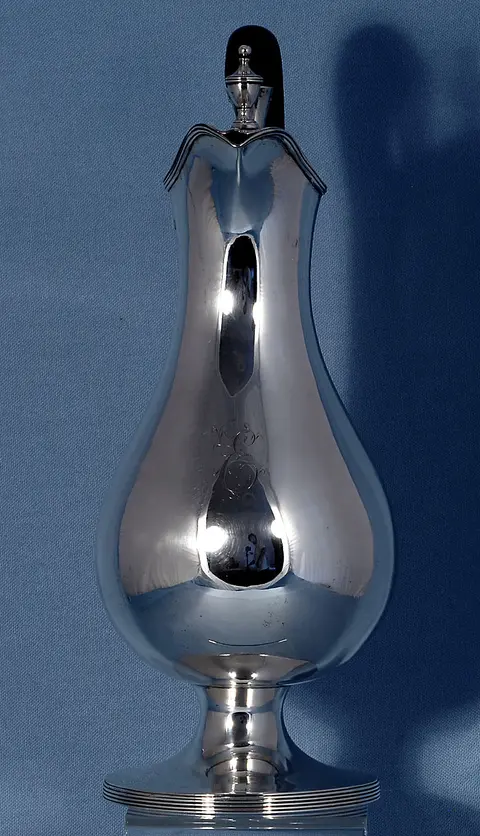
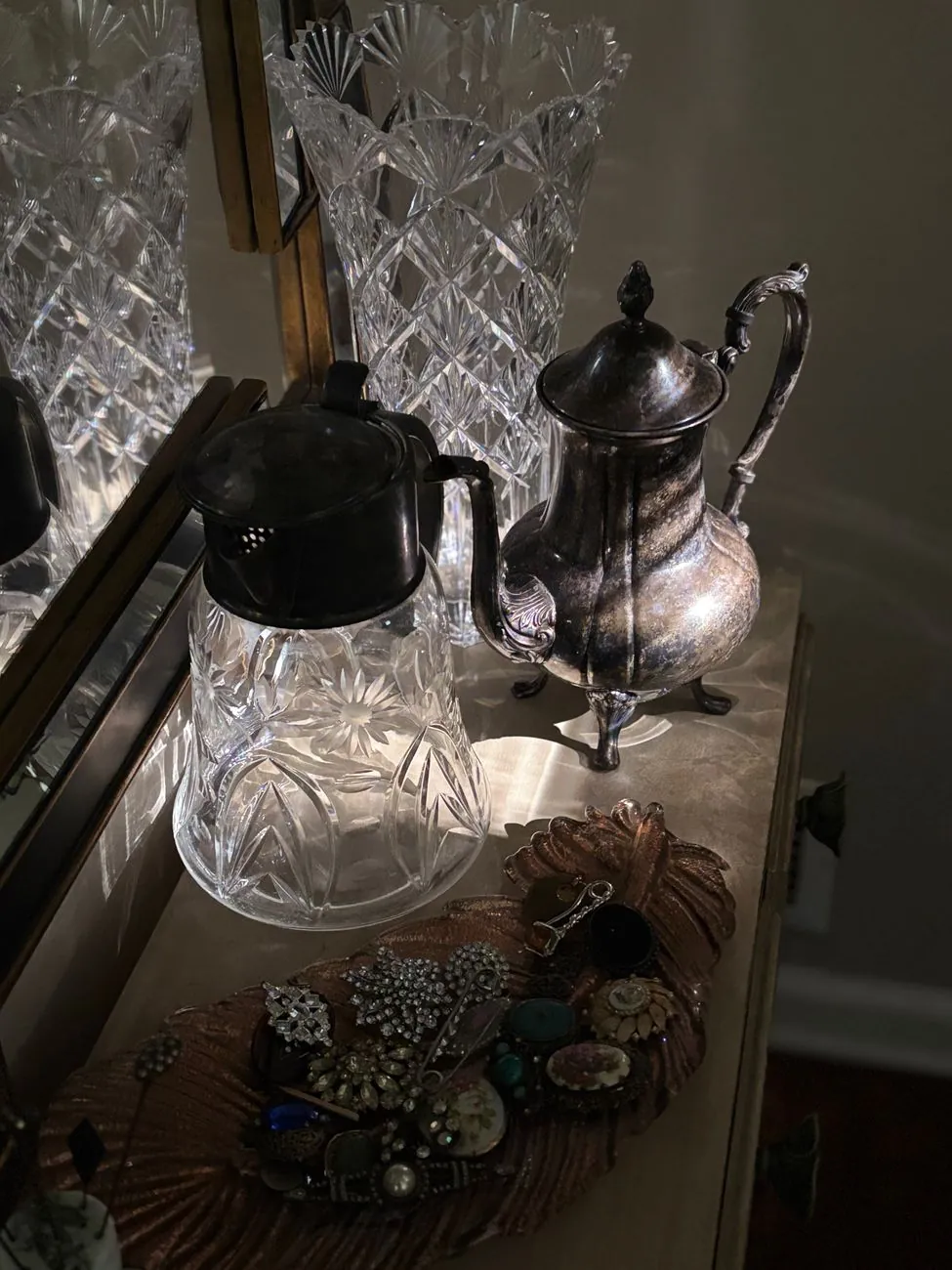
The Victorian contribution was the claret jug, a tall glass body with a silver neck, hinged lid and handle. The glass may be plain, cut, engraved or etched, and the mounts range from plain bands to cast vine leaves and masks. All-silver jugs and ewers in the form of classical vases were made alongside them.
The archive's claret jugs include London and Sheffield examples from the 1860s to the 1880s.
Its wider group of wine-related silver takes in funnels, coasters, and labels. The earliest piece among them is a wine jug of 1787 with the mark of Hester Bateman, the London silversmith known for light Neoclassical work with beaded borders.
With mounted jugs the glass decides the value. Look for chips under the collar, cracks radiating from the handle mount, and cloudiness inside from wine left to dry. A replaced body is hard to spot; the fit of the mount and wear on the base are the clues.
Candlesticks for the dining table
A table laid for wine was lit by candles, and candlesticks are the other English silver most often seen in the city's dining rooms. In the first half of the eighteenth century they were cast in solid silver, which makes them heavy and durable. From the 1760s and 1770s Sheffield makers stamped them from thin sheet in steel dies and filled the hollow with pitch or plaster, a cheaper method that allowed tall columns and crisp Neoclassical detail. These are called loaded candlesticks. The archive's candlestick records include both kinds, among them a pair of Corinthian columns hallmarked in London in 1766.
Each part should be marked: the base with the full set, and the detachable nozzle, the small drip pan that lifts out of the socket, with at least the lion and the maker. A loaded stick must never go in a sink, because water that gets past the base plate swells the filling and splits the thin silver skin. It cannot be valued by weight either, since most of the weight is filling.
Silver from the boating life
A boating city collects maritime objects. Yacht and sailing clubs gave silver prizes for most of the twentieth century, usually a two-handled cup, a bowl or a tankard, and many families here hold one won by a parent, at a club in Florida or one left behind in the north or in Britain. An inscription naming the club, the race and the year turns such a piece into a document. Leave it as it is, and write down who the winner was while someone still remembers. The archive's tankards run from baluster mugs of the reigns of George I and George II to straight-sided presentation pieces of the 1930s. Many later prizes are plated; a cup stamped EPNS, with no lion, is electroplate.
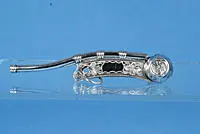
One English naval form turns up in local cabinets more than might be expected: the boatswain's call, the high-pitched pipe used to pass orders aboard ship. It has four named parts. The gun is the tube, the buoy is the hollow ball at its end, the keel is the flat plate beneath, and the shackle is the ring for a chain. The archive has a group of them under bosun's whistles, all assayed in Birmingham between the 1850s and the 1930s, the earlier ones with Queen Victoria's head beside the anchor.
Marks on mounted pieces
Silver mounts on glass are thin, and their marks are small and sometimes stretched. Look on the neck band, inside the lid and on the handle. Each should have the lion passant, and the neck should carry the full set with town mark, date letter and maker. On coasters the marks are on the gallery, usually near the base. Funnels are marked on the bowl, with part marks on the strainer and ring.
For London the town mark is a leopard's head, for Sheffield a crown until 1974, for Birmingham an anchor. A sovereign's head appears between 1784 and 1890. The archive's guide to British hallmarks sets out the system. Pieces of the 1890s and later in earlier styles are revivals, correctly hallmarked for their own year.
Canal houses, boats and salt
Waterfront living exposes silver to salt from two directions, the ocean breeze and the tidal canal behind the house. Chlorides settle on the metal, hold moisture and cause pitting that cannot be polished away. The defence is routine.
- Display wine silver in a closed, air-conditioned room, not on a bar that opens to the dock.
- After a party outdoors, wash every piece the same evening in warm soapy water and dry it by hand.
- Rinse claret jugs with warm water, never hot, and let them drain upside down with the lid open. Do not leave wine in them overnight.
- Keep antique silver off the boat entirely.
- Store spare pieces in acid-free tissue or tarnish-resistant cloth, clear of rubber, wool, felt and newsprint.
Coasters need a separate word. Their wooden bases swell in humidity and shrink in dry cooled air, and repeated wetting loosens the silver rim. Wipe them; never immerse them.
Low-lying streets near the canals flood in storms and at the highest tides. Before the first of June each year, photograph your silver and its marks, list it, and keep the file online. Store silver above ground-floor level if you can. Glass-bodied jugs should be wrapped and boxed when a hurricane approaches, and kept away from windows. Anything touched by flood water should be rinsed in fresh water straight away.
Speak to your insurer about how silver and antiques are covered and whether individual items must be scheduled with a valuation.
Finding out what you have
A formal valuation for insurance or an estate is the work of an independent appraiser who charges for the document. Where wine silver is part of a larger houseful of antiques, a buyer's assessment gives a quick sense of the whole. Premier Estate Buyers publishes a page for antique buyers serving Fort Lauderdale, listing antiques, fine art, collectibles and silver among the things it sees, with free appraisals that carry no obligation and in-home evaluations for larger collections and estates.
Where the question is about silver alone, the related firm Estate Buyers Boca Raton, which describes itself as a family business working since 1984, sets out its method on a page for silver buyers serving Fort Lauderdale. Sterling is weighed against the live spot price, which sets the minimum; complete patterns, recognised makers and collectible forms can bring more; silverplate has negligible value as metal; and house calls across the city and Broward County are private and by appointment. That description matches the distinction drawn throughout this archive between the scale and the object, and it is worth having both figures stated separately for any piece with a maker's name.
The archive's guide to choosing a buyer for antique silver lists the questions to put to anyone who offers an opinion.
The two pages to the north continue the subject: Deerfield Beach on fish silver, salts and plate, and Boca Raton on boxed table services.