Silversmith
Elkington and Co
Elkington and Co of Birmingham changed the silver trade in the nineteenth century. George Richards Elkington, working with his cousin Henry Elkington, patented the first commercially successful process for electroplating in 1840, and the firm opened a large works in Newhall Street, Birmingham, the following year. With the pen manufacturer Josiah Mason as a partner it traded for a time as Elkington, Mason and Co; from 1861 the style was Elkington and Co, and in 1887 it became a limited company.
Electroplate made the firm's fortune, both through its own goods and through licences sold to other manufacturers, but Elkington was also a serious maker of sterling silver. It employed trained designers and modellers, exhibited at the international exhibitions from 1851 onwards, and produced presentation pieces and table silver in every revival style of the period. After George Richards Elkington died in 1865 the business passed to his sons, among them Frederick Elkington, whose personal mark is filed separately in this catalogue under his own name.
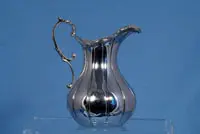
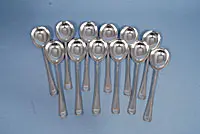
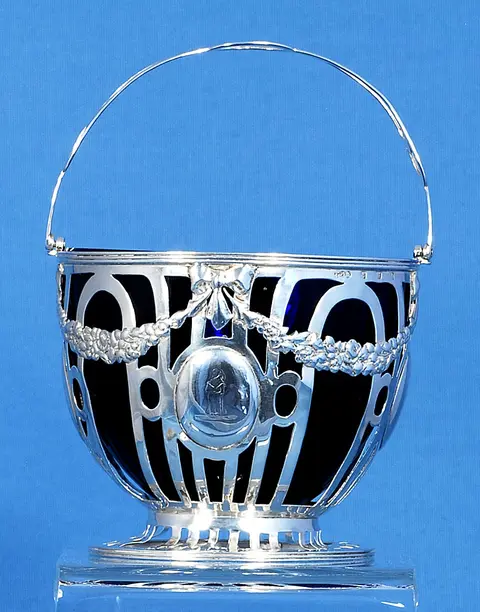
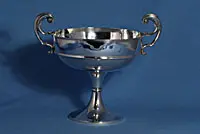
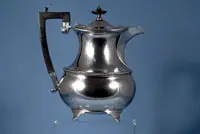
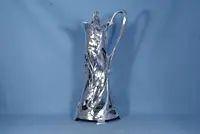
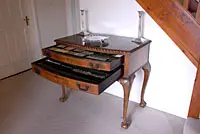
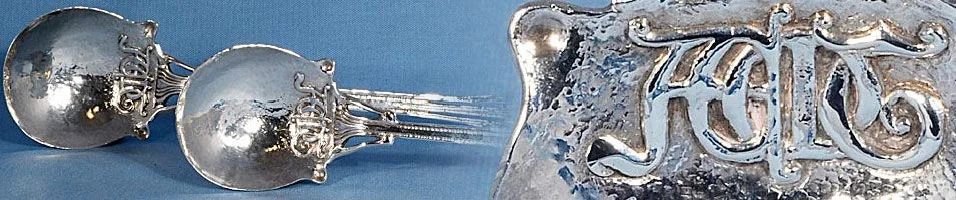
Twelve records are held under Elkington and Co, dated 1852 to 1920, with hallmarks from Birmingham, London and Sheffield. They are all sterling, not plate. The group includes a large cream jug of 1852, a 34-ounce Art Nouveau rose bowl hallmarked at Sheffield in 1907, a two-handled fruit bowl of 1910, a set of twelve bright-cut soup spoons of 1905 and a coffee pot of 1917.
Elkington and Co appears in the catalogue with 12 pieces, hallmarked between 1852 and 1920. Each record below keeps the photographs and description from the original listing.
In the catalogue
- Records
- 12
- Hallmark dates
- 1852 to 1920
- Most common kinds
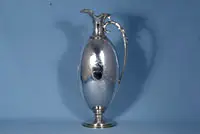
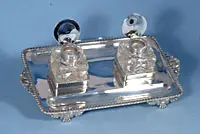
- Cream Jugs (1), Ewers (1), Inkstands (1), Spoons (1).
- Assay offices
- Birmingham (3), Sheffield (3), London (2).
- Periods
- Edward VII (6), Victorian (3), George V (3).