Kind of silver
Rose Bowls
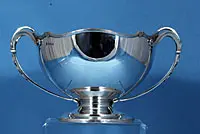
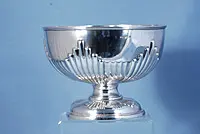
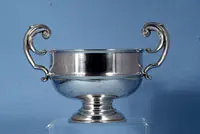
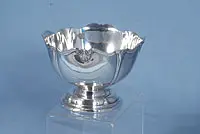
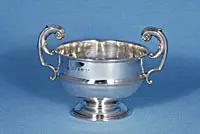
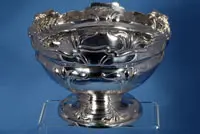
Rose bowls came into fashion in the 1880s. They are large, deep bowls on a spreading foot, made to hold cut flowers in the centre of a table or on a sideboard, and they were supplied with a removable grille of silver or plated wire to keep the stems apart. Many borrow the fluted body and shaped rim of the seventeenth-century monteith. Others are plain half-spheres with a band of Celtic or Art Nouveau ornament.
Their size and broad plain surfaces made them the standard sporting trophy and presentation gift of the years before 1914, and a great many carry inscriptions. Some stand on an ebonised wooden plinth, which may bear silver plaques with winners' names. Check whether an inscription has been erased, whether the grille survives, and for dents in the foot. Weight varies a good deal between makers.
Six records are held, 1903 to 1919. They include a large Sheffield bowl of 1907 by Elkington and Co, Birmingham bowls of 1910, one of them by J Gloster Ltd, and an Art Nouveau bowl of 1911 by E. S. Barnsley & Co.
The catalogue holds 6 records filed under rose bowls, dated 1903 to 1919. They are listed newest first.
 Illustration
In the catalogue
- Records
- 6
- Hallmark dates
- 1903 to 1919
- Makers
- J Gloster Ltd (2), Cooper Brothers & Sons Ltd (1), James Dixon & Sons (1), E.S.Barnsley & Co (1).
- Assay offices
- Sheffield (3), Birmingham (3).
- Periods
- Edward VII (4), George V (2).