Boca Raton was laid out for entertaining. When the town was incorporated in 1925 it engaged the architect Addison Mizner as its planner, and his Cloister Inn, which opened in February 1926, set the Mediterranean Revival manner that the city still borrows from: loggias, courtyards, and dining rooms meant to seat a party. The Town Hall completed in 1927 on a Mizner foundation now houses the local history museum. Houses built in that spirit, and the country-club communities that followed, were furnished with dining tables, and dining tables were furnished with silver.
How English table silver reached Boca Raton
Very little of it was bought here. The usual route is a family one. A couple retires from New York, Chicago, Toronto or the English Home Counties, and the fitted oak box of forks and spoons that came down from a grandmother travels south with the furniture. Seasonal residents keep a second household and stock it from the first. A generation later the box is opened by heirs who know it is silver and little else.
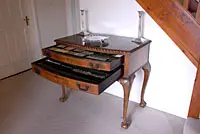
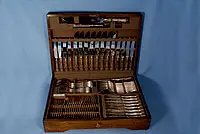
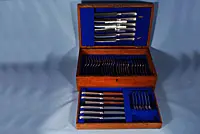
That box is called a canteen, and the archive holds a long run of them under canteens of cutlery. They range from Georgian services built up over decades to twentieth-century sets supplied complete by a single Sheffield firm. Reading a few of those entries before you unpack your own is the quickest way to learn the vocabulary: table fork and dessert fork, tablespoon and dessert spoon, place setting, straight service, matched service.
What a canteen should contain
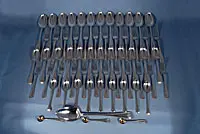
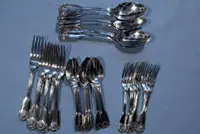
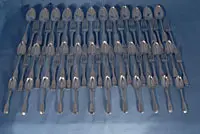
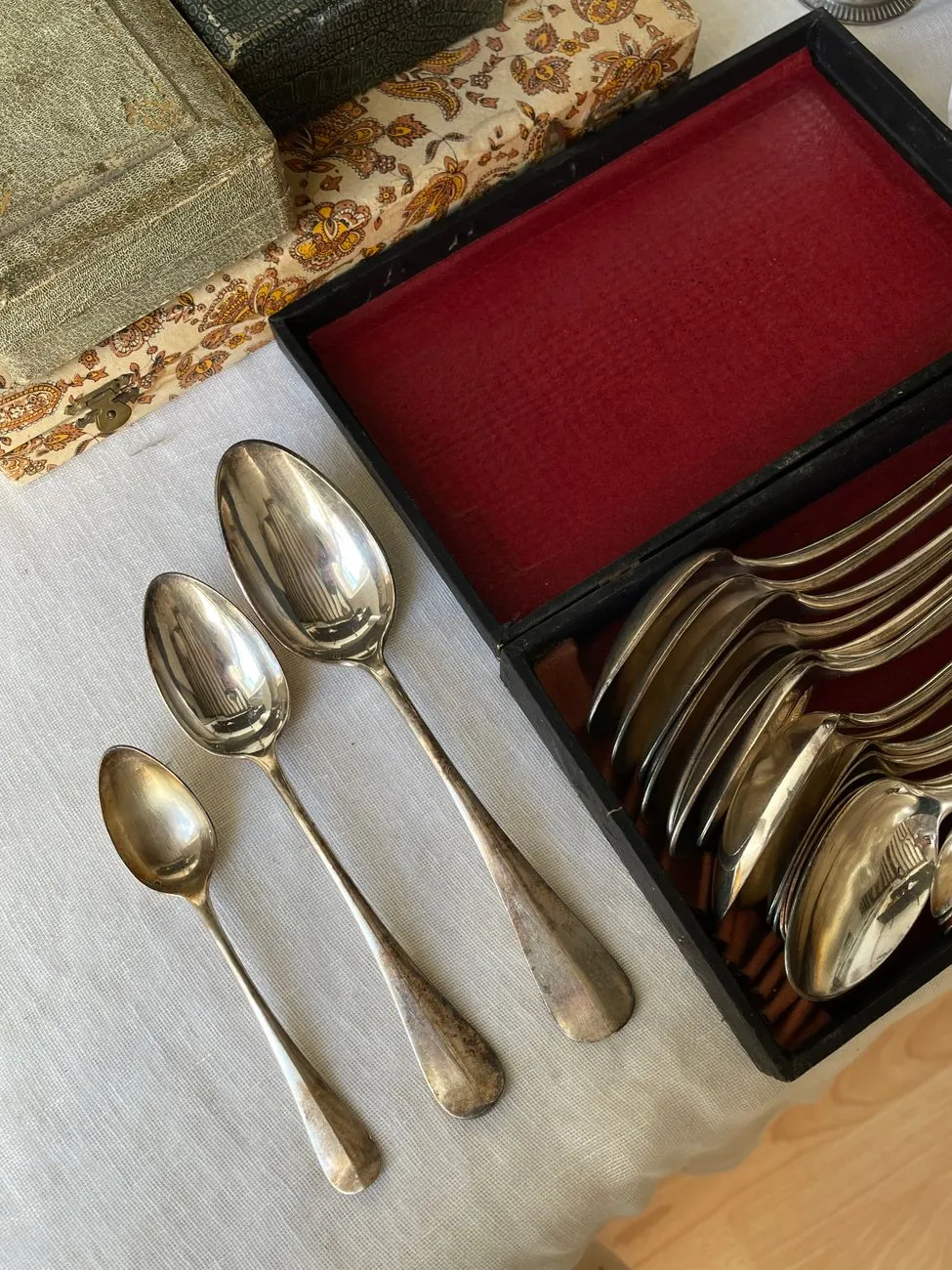
An English service was sold by the dozen. Twelve table forks, twelve dessert forks, twelve tablespoons, twelve dessert spoons and twelve teaspoons made the core, with soup ladle, sauce ladles, basting spoons and fish servers added by wealthier buyers. Knives are a separate matter, because their steel blades wore out and were replaced, so the knives in an old canteen are often later than everything else.
Patterns matter more than most owners expect. Old English is plain with a turned-down end. Fiddle has the shouldered, violin-shaped stem. Fiddle and Thread adds a raised line round the edge, and King's pattern carries shells and scrolls on both faces. The entry for a George IV canteen in Fiddle, Shell and Thread shows how a cataloguer names a pattern and counts the pieces. Count yours the same way, on a towel, in rows, and write the totals down.
- A straight service has one maker and one date letter throughout, and is the scarcest kind.
- A matched service keeps one pattern but mixes makers and years. Most Georgian canteens are matched.
- A part service has gaps. Note what is missing; do not buy replacements before you have had advice.
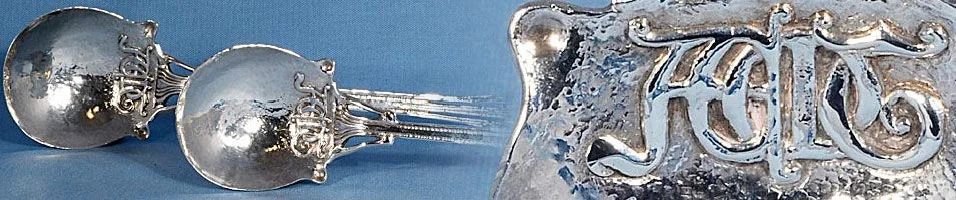
- Monograms and crests are part of the history of the set. Leave them alone.
Reading the marks on a fork
Turn a fork over. On English flatware the marks sit on the back of the stem, in a row near the bowl on early pieces and nearer the end from the late eighteenth century. You are looking for four or five small punches. The lion passant certifies sterling. A leopard's head stands for London, an anchor for Birmingham, a crown for Sheffield on pieces assayed before 1975. A single letter in a shield gives the year, and a pair of initials gives the maker. A sovereign's head in profile, struck from 1784 to 1890, records duty paid. The archive's guide to British hallmarks explains each punch and how the date letters cycle.
Initials lead to names. Many of the Georgian and Victorian spoons and forks recorded here came from a small group of London flatware specialists, among them William Eley and the Chawner workshop, and their marks recur in services found all over the English-speaking world. If your forks say STERLING in words, they are American. If they say EPNS or A1, they are plated.
Sterling, plate and American silver in one sideboard
A Boca Raton sideboard seldom holds one thing. The English canteen sits beside an American sterling service bought for a wedding in the 1950s, a plated tea set, and a drawer of odd serving pieces. Sorting them takes an hour and saves confusion later.
American sterling is stamped with the word and usually a maker's name or trademark, and its patterns have names that can be looked up. English sterling has the row of pictorial punches described above and no word. English electroplate carries a maker's name or initials with letters such as EPNS, EP or A1, and sometimes a set of small shields laid out to resemble hallmarks; the absence of the lion passant gives it away. Elkington of Birmingham, who patented commercial electroplating in 1840, also made solid silver, and the archive's Elkington records include a sterling canteen of the 1920s, so the name alone settles nothing. Read the marks on each piece.
Put the three groups in separate trays. Plated wares have little value as metal, though good ones are perfectly usable. The sterling groups should each be counted and listed on their own sheet.
Dividing a service among heirs
Families often split a canteen so that each child receives a share. It is a generous instinct and an expensive one. Twelve settings divided among three households become three part services, none of which can lay a full table, and the premium that attaches to a complete set is lost for good. Where the silver is to stay in the family, consider letting one person keep the service whole and balancing the gift with something else. Where it is to be sold, sell it complete, in its box, with the key if there is one.
The same reasoning applies to serving pieces. Soup ladles, basting spoons and fish servers that match the pattern of the forks belong with them. A cataloguer will always note that a service is offered "with matching servers", and the archive's entries for flatware show how often that phrase carries weight.
The rest of the sideboard
Table services rarely travel alone. The same households brought tea silver, and an English tea set of the nineteenth century has three pieces, teapot, sugar bowl and cream jug, with a coffee pot or hot-water jug making a fourth. Shapes date a set nearly as well as marks do. Oval, straight-sided pots with engraved borders belong to the 1780s and 1790s, low oblong pots on ball feet are Regency, and round, lobed bodies with cast flower borders are the taste of William IV and the young Victoria. The archive's three-piece set by John Wakefield, London 1833 shows that last form clearly. Each piece of a set was hallmarked separately, so a teapot and jug a year or two apart by one maker are still a set, while a London pot with a Sheffield bowl is a marriage.
Then there is the shoebox. Many Boca Raton closets hold a collection of small silver formed by a parent over decades: flat boxes with hinged lids and gilt interiors for snuff, slim cases for visiting cards decorated with views of famous buildings, short wide-bowled spoons for measuring tea. Most were assayed in Birmingham, whose town mark is an anchor, and the marks are two or three millimetres high, struck inside the lid and on the rim of the base. The archive's snuff boxes are its largest single group and give dated comparisons for nearly every decade from 1800 to 1900. Pieces of this kind are judged as objects, by maker and condition, and should never be put on a scale with the forks.
Keeping silver in a coastal house
South Florida is hard on silver for two reasons. Humid air speeds the reaction with sulphur compounds that produces tarnish, and salt carried in from the ocean attacks the surface more aggressively, leaving small dark pits if it is allowed to sit. Air conditioning is the best protection you already own. Keep the canteen in a room that is cooled all year, including the months when a seasonal house stands empty, and never in a garage, a pool cabana or an unconditioned storage unit.
Inside the box, each piece should lie in its own slot. If the lining has perished, wrap pieces in acid-free tissue or in bags of tarnish-resistant cloth. Rubber bands, newspaper, wool felt and cling film all mark silver, rubber worst of all. Wash used pieces by hand, dry them at once, and keep salt and egg off them overnight. The older advice in the archive's note on cleaning silver still holds: polish seldom, and cover the hallmarks when you do.
Storm preparation for silver is mostly paperwork. Photograph the open canteen, then each type of piece front and back, then the marks in close-up with raking light. Record the count, the pattern and any weight you can take on a kitchen scale. Store the pictures somewhere that is not in the house. If you evacuate, a canteen is one of the few valuable things that carries easily in a car; if it stays, it belongs on an upper shelf of an interior cupboard, clear of windows and floor-level water.
Check what your household policy says about silverware. Many policies limit theft cover for silver unless items are listed separately, and listing requires a written valuation.
Having a service looked at
Three kinds of opinion exist and they answer different questions. An insurance valuation gives the cost of replacing the service at retail. A fair market appraisal, written by an independent appraiser who charges a fee and does not buy, is what an estate needs. A buyer's opinion is free and tells you what the trade would pay now. For the last of these, Estate Buyers Boca Raton describes itself as a family firm working since 1984 and offers free appraisals with no obligation, at its office or by private appointment at home; the firm's own page on estate buyers in Boca Raton sets out what it handles, which includes silver alongside jewellery, coins, art and whole estates.
Estates raise a separate need. When a house in Boca Raton is being settled, the executor usually has silver, jewellery, watches and pictures to account for at once, and wants one visit that covers them all. Premier Estate Buyers, the related firm, describes an appraisal service in Boca Raton that takes in silver, antiques and collectibles as well as jewellery, mentions probate appraisals of estate assets, and advises anyone who needs findings in a particular written format, for an insurer for instance, to say so when booking. A buyer's findings do not replace an independent fee appraisal where a court or a tax return requires one, and it is reasonable to ask at the outset which kind of document you will receive.
Whichever opinion you seek, arrive with your own notes. A person who can say "twelve settings, Fiddle and Thread, London, mixed dates from the 1820s to the 1850s" is treated differently from one who says "a box of old silverware". The archive's piece on valuing inherited antique silver walks through that preparation in order.
Two neighbouring pages continue the subject. Deerfield Beach, just across the county line, deals with fish silver, salts and telling sterling from plate, and Fort Lauderdale covers wine silver and the particular problems of a house on the water.