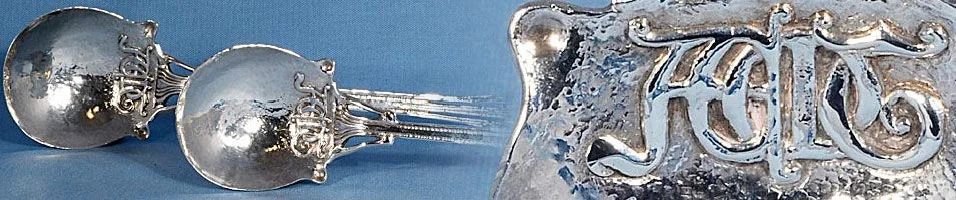
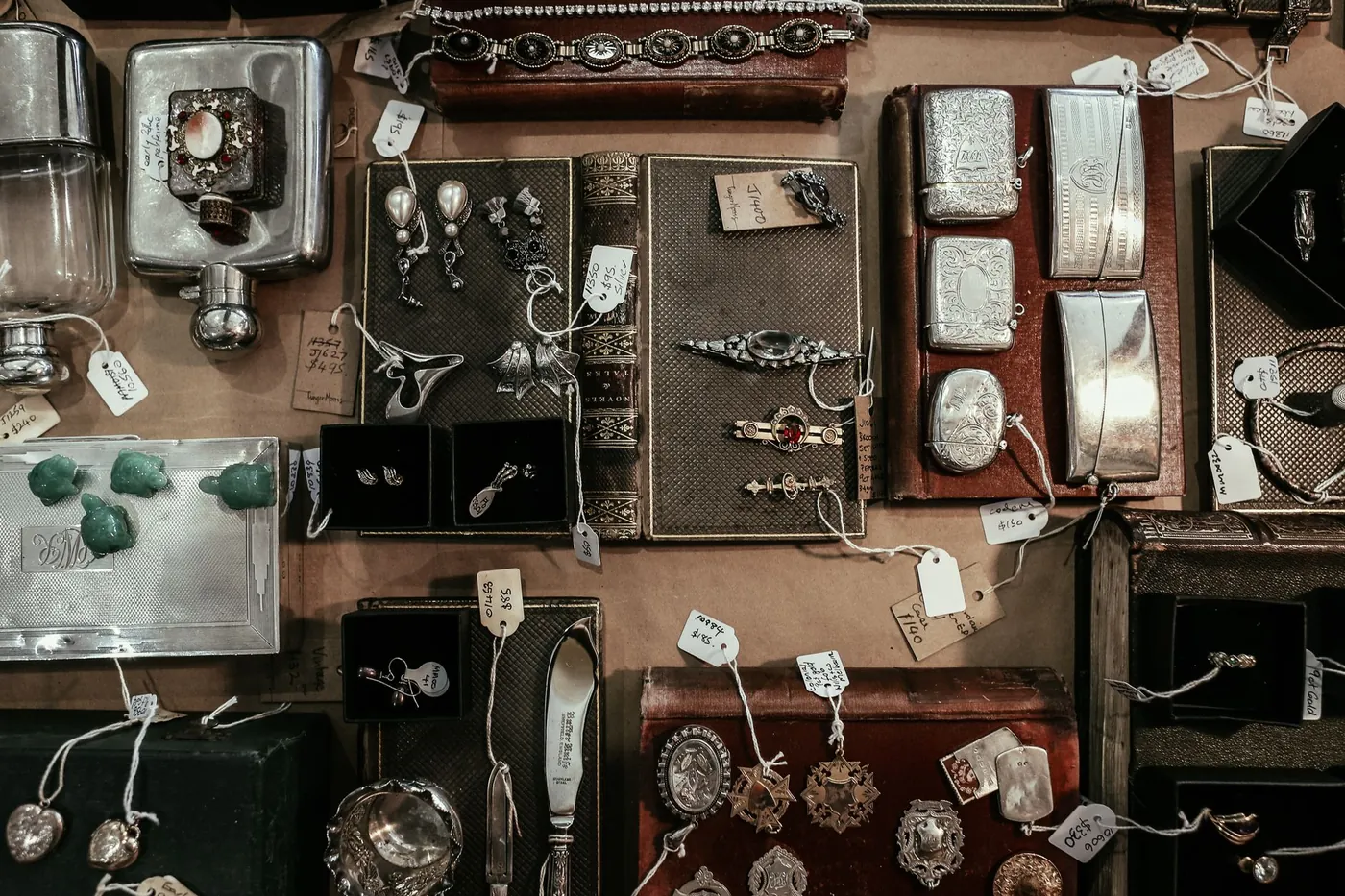
The first job with an inherited collection is to slow down. Silver that has sat in a dining room in Palm Beach or Broward county for forty years will not lose anything by sitting for another month, and most of the damage done to family silver happens in the first week after a death, when things are polished, divided and carried off before anyone has written down what was there. The steps below are in the order that protects both the objects and the family's options.
Leave everything as it is
Do not polish. Tarnish is a surface film and does no harm in the short term, while each polishing removes a little metal and softens engraving and marks. Chemical dips are harsher still: they strip the dark oxidation from the recesses of chased decoration, which leaves a piece looking flat and white. Appraisers and buyers prefer to see silver untouched. If something has to be handled, a dry cotton cloth is enough. The archive's page on cleaning silver covers the gentler methods for pieces the family decides to keep.
Leave things in their boxes and cases, and keep the boxes. A fitted case, a retailer's label inside a lid, an old insurance schedule, an auction invoice or a dealer's receipt tucked into a drawer can each add to what is known about a piece. Gather any such papers into one folder before the house is cleared. Avoid sticking adhesive labels or tape to silver; a paper tag on a loop of string does the same job without marking the surface.
Make an inventory
Give every object, or every set, a number and a line in a list. A spreadsheet is convenient, but a notebook works. Record the same facts for each entry.
- What the object is, in plain words: teapot, pair of candlesticks, twelve dessert spoons.
- Every mark you can see, drawn or described, and where on the piece it is struck.
- Height or length, and weight in grams for anything that is not filled or mounted.
- Engraved initials, crests, coats of arms, dates and presentation inscriptions, copied out exactly.
- Visible damage: dents, splits, repairs, missing finials or liners.
- Where it was found and what it was found with, including its case.
The inventory is worth the hours it takes. It lets heirs in different states discuss the same list, it gives an attorney or executor something to work from, and it means that an appraiser or buyer can be sent a description in advance.
Read the marks
A ten-power loupe and daylight are the only tools needed. On spoons and forks the marks are on the back of the stem. On teapots, jugs and bowls they are usually under the base or in a line near the handle, and on salvers and trays on the underside. English sterling shows a lion passant, a town mark, a date letter and a maker's mark; the archive's guide to British hallmarks explains each of them and how they changed, and the pages for each assay office list the town marks.
A quick first sort by period is possible without a reference book. A sovereign's head among the marks places a piece between 1784 and 1890, when duty was charged on silver. Queen Victoria's head faces left; the heads of George III, George IV and William IV, with rare early exceptions, face right. That is enough to separate Georgian silver from Victorian at the kitchen table. Exact years come from the date letter, read against the table for the right town.
Check detachable parts as well as bodies. The lid of a teapot or tankard, the stand of a kettle and the burner beneath it should each carry at least a lion and a maker's mark that agree with the main set. A lid with no marks, or with different ones, suggests that two objects have been put together at some point, which an appraiser will want to know. Note makers' initials carefully and resist matching them to a famous name too soon. The script HB of Hester Bateman, for instance, is among the most often misattributed marks in English silver, because other makers shared the initials.
Sort into sterling, plate and continental silver
With the marks noted, the collection can be laid out in groups. Most households that collected English silver will produce four.
- British sterling. Fully hallmarked pieces with the lion passant, or the thistle of Edinburgh or the crowned harp of Dublin. Pieces with a figure of Britannia in place of the lion are of the higher Britannia standard and belong here too.
- Plate. Old Sheffield plate, which is silver fused over copper and shows a pink tinge where it has worn, and later electroplate stamped EPNS, EPBM or A1. Plate often bears rows of small punches arranged to look like hallmarks, but never the lion.
- Continental silver. Pieces stamped with a number such as 800, 830, 835 or 900, which gives the parts of silver in a thousand. German silver made after 1888 pairs the number with a crescent moon and crown. French silver of the higher standard carries a small head of Minerva. These alloys hold less silver than sterling, yet they are solid silver and are frequently mistaken for plate.
- American silver. Usually stamped with the word STERLING and a maker's name or trademark.
Anything unmarked or unreadable goes into a fifth group for an expert to look at. Do not discard the plate. Early Sheffield plate in good order has collectors of its own, and even ordinary electroplate may complete a tea service that is otherwise sterling. The same method serves for the other antiques in the house. Porcelain, bronzes, clocks and pictures each get a number, a description, a note of marks or signatures and a record of damage.
Photograph each piece
Photographs turn the inventory into something that can be sent to a specialist. Work near a window in indirect daylight and switch off the flash, which bounces off polished metal and hides everything useful. A sheet of grey or off-white card makes a plain background. Take one view of the whole object, one of the underside, a close view of the marks with the light falling across them from the side, and one of each inscription and each area of damage. Put a ruler in at least one frame. Name the files with the inventory numbers so that pictures and list can be matched by someone who has never seen the collection.
Keep sets and pairs together
Much of the value in domestic silver lies in completeness. A tea service in which teapot, sugar bowl and cream jug share a maker and a date letter is worth more than the three pieces sold apart. A pair of candlesticks is worth clearly more than two single sticks, and a set of four more again. A canteen of flatware loses value with every place setting removed. Cased sets, such as christening spoons and forks or sets of salts with their spoons, should stay in their cases.
This matters most when a collection is to be shared among heirs. Dividing a service of flatware so that each of three children receives four place settings leaves three incomplete sets that no collector wants. It is better to divide by value: one heir takes the canteen, another the tea service, and the difference is settled in other objects or in money. The inventory makes that kind of division possible.
When to get an appraisal, and from whom
Three different figures are commonly called a valuation, and they are not interchangeable. An insurance value is the cost of replacing a piece from a retail dealer and is the highest of the three. A fair market value is what a willing buyer would pay a willing seller, and is the figure used when an estate has to be reported or divided; where a formal document is needed, it comes from an independent appraiser who charges a fee and does not buy. The third figure is a buyer's offer, the sum actually available on the day.
A buyer's appraisal costs nothing because it is the first step towards an offer, and it should be read in that light. It is still useful early on, since it shows which pieces the market takes seriously. For a household where silver sits alongside porcelain, bronzes and pictures, families in the area can arrange an antique and collectibles appraisal in Boca Raton with Premier Estate Buyers, a firm that dates its work to 1984 and describes its appraisals as free, with no obligation to sell and with home visits across South Florida.
Seek a paid, written appraisal before selling if the inventory has turned up any of the following: silver dated before about 1750, pieces with the marks of major makers, armorial engraving that can be traced to a family, or a large matched service. For such things the cost of the document is small beside the risk of underselling.
Choosing how to sell
Once the family has agreed what is to be kept, the remainder can go by one of three routes. Auction suits the few pieces with a strong maker or an early date; it takes months, and the house deducts commission. Consignment to a dealer is slower still. Direct sale suits the larger part of most collections, the sound but ordinary Victorian and later silver, the plate and the mixed household antiques, and it is the practical route when a property has to be emptied to a deadline. Established antique buyers in Boca Raton will look at a single item or a whole estate, at their office or in the house, which spares the family the packing.
Whichever route is taken, the work done at the start pays for itself. A numbered list, clear photographs of the marks, sets kept whole and surfaces left alone put the family in the position of knowing what is on the table before anyone names a price for it.