A pier town and its fish knives
Deerfield Beach has fished from its pier since the early 1950s, when the first wooden structure was built out from the beach. The settlement itself goes back to the 1890s under the name Hillsborough, and it added "Beach" to Deerfield in 1939 to tell visitors what it had. It is a fitting place to consider the silver that the English made for serving fish, which survives in quantity in the town's condominiums and retirement communities, brought down by owners from the Northeast, the Midwest, Canada and Britain.
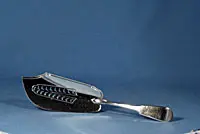
The fish slice came first. It appears in the second half of the eighteenth century as a broad, flat blade, pierced in a pattern so that liquid could drain, on a handle of silver or another material. Early blades are shaped like a trowel. By the early 1800s the blade had become long and asymmetrical, like a wide knife, and the archive's fish slice hallmarked in London in 1809 shows the form.
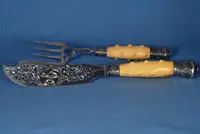
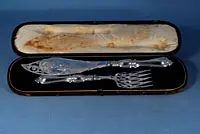
The Victorians paired the slice with a large fork, engraved both with scrolls, foliage and sometimes fish, and sold them in a fitted case. Those pairs are the fish servers recorded in the archive from Sheffield and Birmingham in the 1840s and 1850s.
Individual fish knives and forks for each diner came later in the nineteenth century, and sets of six or twelve with matching servers were a standard wedding present well into the twentieth.
Why so much of it is plated
Fish sets are the pieces most often found in electroplate. The blades were large, a full set was costly in solid silver, and the Sheffield and Birmingham factories that dominated the market from the 1840s offered every pattern in both qualities. Two firms whose sterling is recorded in this archive, Mappin and Webb and Walker and Hall, were also among the largest makers of plate, so the name on the case or the blade does not answer the question.
The marks do.
- Sterling has the lion passant. On Sheffield silver it stands beside a crown, the town mark until 1974; on Birmingham silver beside an anchor.
- Electroplate is stamped EPNS, EP, A1 or with a trade name, and has no lion.
- Walker and Hall's plate carries a small pennant flag with the firm's initials. Their sterling carries the flag too, alongside full hallmarks.
- On fish knives the blade and the handle are separate parts. A sterling blade with a filled handle, or a plated blade with a sterling collar, are both common. Read each part.
The crown of Sheffield is explained, with the archive's dated Sheffield pieces, on the page for the Sheffield assay office.
A simple order of tests
Before taking anything to be looked at, an owner can settle most questions at the kitchen table. First, the loupe: find and read every mark. Second, wear: on plate that has seen long use, the yellowish nickel or pinkish copper base shows through on the high points and the edge of the blade. Sterling wears to more sterling. Third, weight in the hand: filled handles feel heavy but dead, and often rattle or show a seam where the two stamped halves meet.
Do not file, scratch or apply acid yourself. A test cut in a hallmarked English blade proves nothing the lion has not already told you, and it leaves a scar. Magnets are of little use either, since neither silver nor the usual base metals of English plate are magnetic.
Good plate has a place. A cased Victorian set in electroplate with sharp engraving is a handsome, usable thing. It simply has no value as metal, and should be described as plate.
Salt at the table
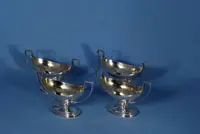
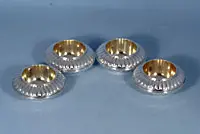
Fish is eaten with salt, and salt is the oldest enemy of silver. Left in a silver cellar it draws moisture from the air, and the brine eats into the metal, leaving black spots and then pits. English makers answered the problem in two ways. They gilded the inside of the bowl, since salt does not attack gold, or they fitted a liner of blue glass inside a pierced silver frame. Both devices are found on the salt cellars in the archive, which were made in pairs and in sets of four because a formal table placed one between every two diners.
Shapes follow the periods. Low round bowls on three feet belong to the middle of the eighteenth century, pierced ovals to the 1770s and 1780s, boat shapes on a pedestal foot to the 1790s, and oblong salts on ball feet to the Regency. The archive's set of four by Robert and David Hennell, London 1798 shows how a matched group is catalogued. Check your own for worn gilding, which shows as a pale patch at the bottom of the bowl, and for chipped or missing liners. Empty salts after every meal and never store salt in silver, lined or not.
Metal value and where it stops
Every sterling piece has a floor under it, the value of its silver. Sterling is 925 parts in a thousand. The piece is weighed, the weight is converted to troy ounces of about 31.1 grams, multiplied by 0.925 and by the day's price for silver, and a margin is taken off for refining. Filled knife handles must be left out of the sum, since most of their weight is cement. For worn, incomplete Victorian flatware the result is close to what the piece will fetch. For a cased pair of servers by a recorded maker, or four Georgian salts with one date letter, it is only the starting point.
Estates in the town's retirement communities often hold bullion as well: gold coins, small bars, and jewellery kept for its metal. Those things are priced by weight and fineness alone, and they should be dealt with separately from antique silver so that the two kinds of reckoning are not confused. Premier Estate Buyers has a page on selling gold in Deerfield Beach which covers gold coins, bullion bars and jewellery from 10 to 24 karat, and says each piece is examined, tested and weighed.
Condominiums by the ocean
Many Deerfield Beach residents live within a few blocks of the surf or in large condominium communities further inland. Apartments near the beach take in salt whenever a balcony door is open, and salt is the chief enemy of both silver and plate. On plate the damage is quicker, because once corrosion gets through the thin silver layer it spreads underneath and lifts it.
Keep cased sets closed, in a cupboard in a cooled room, and check that the lining is dry. Old cases have silk and velvet over glued card, which holds damp and can grow mould in a closed-up apartment over the summer. If a case smells musty, air it in a dry room and store the silver separately in acid-free tissue until it is sound. After use with fish, lemon or vinegar, wash blades promptly by hand in mild soap and dry them fully. The dishwasher loosens the cement that holds handles on.
Nothing made of rubber should touch silver. Wool, felt and newsprint are also best avoided. Residents who go north for the summer should leave the air conditioning running at a moderate setting.
Photograph each set open in its case, then a single knife and fork, then the marks. Count the pieces and note any that are missing or replaced. Keep the images outside the apartment. During hurricane season, which runs from June through November, a cased set is easily carried if the building is evacuated; a canteen left behind should sit well above floor level, away from windows.
Condominium policies vary in what they cover for contents. Ask whether silver has a separate limit and whether listed pieces need a valuation.
Asking for an appraisal
Formal valuations for insurance or an estate come from independent appraisers who charge a fee. For a buyer's reading, Estate Buyers Boca Raton, whose office is across the county line in Boca Raton, maintains a page for silver buyers serving Deerfield Beach. It describes a family business working since 1984, lists sterling flatware and hollowware among the silver it handles, and offers free appraisals with no obligation, on a home visit or by appointment at its office.
Whoever looks at a fish set, hand it over with your own note of what the marks say. The archive's guide to how sterling is priced in South Florida explains why sets are worth more kept together.
Up the coast, the Boca Raton page deals with full table services and how to divide or keep them. Down the coast, Fort Lauderdale looks at wine silver, candlesticks and keeping silver in a house on the water.