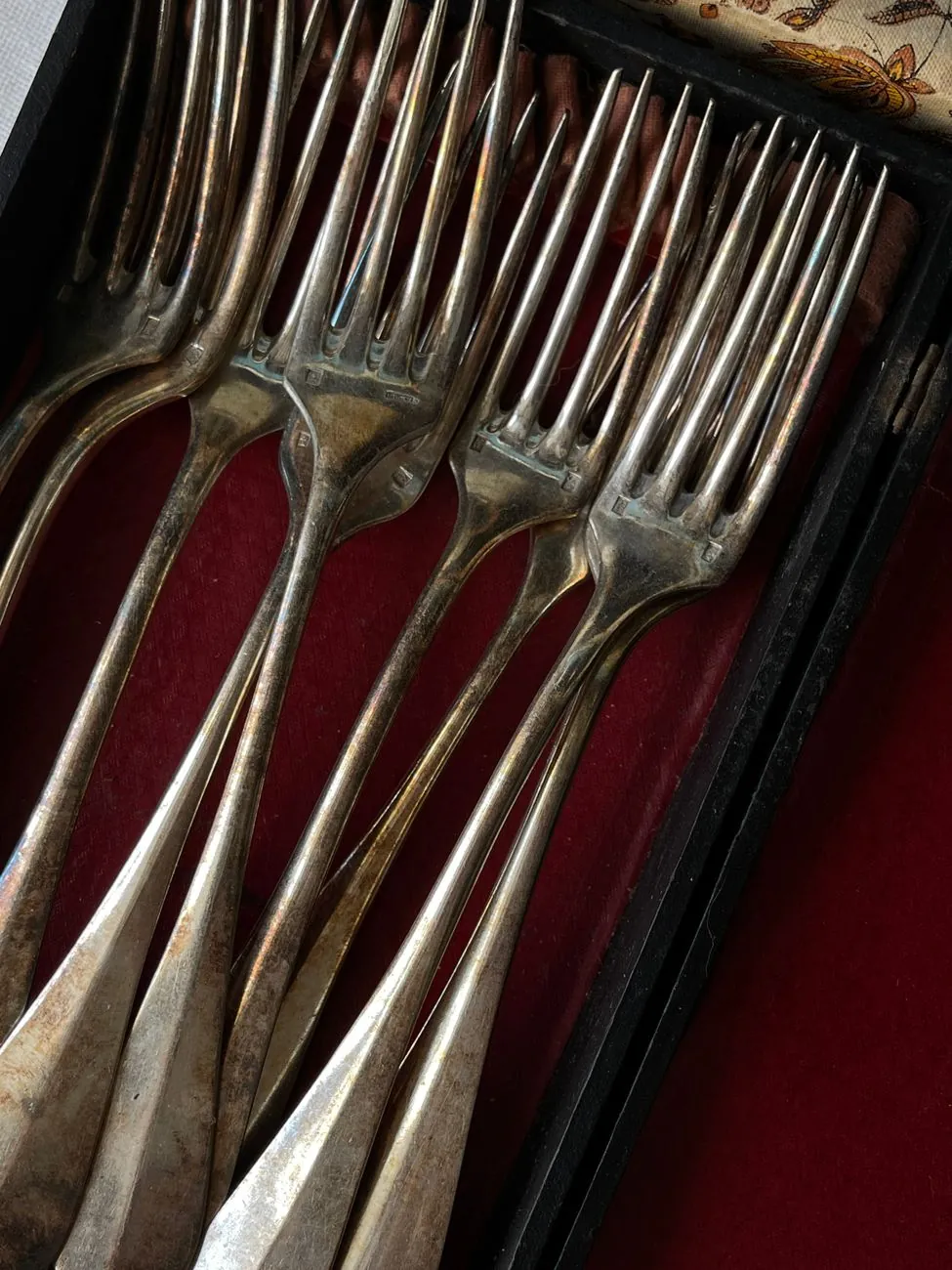
A canteen of London-marked forks in a Florida sideboard is a more common find than it sounds. English silver came to Palm Beach and Broward counties with retirees, with families moving down from the north-east and through decades of buying in antique shops, and a good deal of it is now being sold by people who did not choose it and are unsure what it is. This guide sets out how hallmarked English sterling is assessed when it is offered for sale: what the scale decides, what the marks decide, and where the two part company.
Two prices for the same object
Every piece of sterling has a floor under it, which is the value of its metal. Sterling is 925 parts of silver in a thousand. A buyer weighs the piece, converts the weight to troy ounces (a troy ounce is about 31.1 grams, heavier than the 28.35 gram ounce of a kitchen scale), multiplies by 0.925 and by the day's spot price for silver, then takes off a margin to cover refining and handling. The result is the melt value. It moves every day with the bullion market and has nothing to do with age or workmanship.
The second price is what a collector or dealer would pay for the object as an object. For a worn late Victorian teaspoon the two figures are close together. For a George III salver by a recorded London maker, with crisp marks and its original engraved coat of arms, the second figure can stand well clear of the first. A sound assessment therefore begins by sorting a lot into pieces that belong to the metal market and pieces that belong to the antiques market. Selling a collectable piece by weight is the one mistake that cannot be put right afterwards, because the piece goes to the refiner.
What the marks tell a buyer
English silver carries its own paperwork. The lion passant, a walking lion seen from the side, certifies the sterling standard. Beside it sits a town mark: the leopard's head for London, an anchor for Birmingham, a crown for Sheffield until the 1970s, three wheatsheaves and a sword for Chester, a castle for Exeter. A date letter fixes the year of assay and a set of initials identifies the maker or sponsor. Between 1784 and 1890 a fifth punch, the sovereign's head in profile, shows that duty was paid. Each of these is explained, with the history behind it, in the archive's guide to British hallmarks.
Two variations deserve a second look. If the lion passant is replaced by a seated figure of Britannia and a lion's head torn off at the neck, the piece is of the higher Britannia standard, 958 parts in a thousand, which was compulsory from 1697 to 1720 and has been optional ever since. Such a piece holds slightly more silver to the ounce, and if the date letter confirms the early period it should go to a specialist before anyone puts it on a scale. The other variation is absence: a row of marks with no lion at all. On an English piece that almost always means plate, a subject taken up further down.
Most silver sold in Florida is American and is stamped with the word STERLING. A row of four or five small pictorial punches and no word at all can puzzle a buyer who rarely handles British work. It pays to have read your own marks before the appointment and to be able to say what they are.
Maker and period
Certain names lift a piece out of the metal market at once. Paul Storr, whose Regency plate was supplied through the royal goldsmiths Rundell, Bridge & Rundell, is the best known. Hester Bateman, the Huguenot goldsmith Paul de Lamerie and, in the twentieth century, Omar Ramsden belong to the same short list. Their marks are well recorded and widely faked or misread, so an attribution should rest on the full set of punches and on the quality of the object, never on initials alone.
A famous name is not required for a premium. Early dates count: Queen Anne, George I and George II silver survives in far smaller quantity than Victorian. So do provincial town marks, unusual forms, and a heavy gauge of metal for the size of the piece. At the other end, the die-stamped dressing-table silver, photograph frames and thin tea wares turned out in volume by Sheffield and Birmingham factories around 1900 usually sell near their metal value unless design and condition are well above the ordinary.
Flatware and holloware
The trade divides table silver into two classes. Flatware means spoons, forks and serving pieces, made in standard patterns such as Hanoverian, Old English, Fiddle and King's. Its value lies in sets. A service for twelve in which every piece shares one maker and one date letter, called a straight service, commands more than a service of one pattern assembled from mixed makers and years, and that in turn is worth more than the same pieces sold loose. The archive's records of canteens of cutlery show how complete services were described when they were catalogued. Table knives are a special case: the handles are thin silver shells packed with resin around the tang of a steel blade, so they contribute very little silver and are priced by the piece.
Holloware covers vessels and stands: teapots, coffee pots, jugs, bowls, salvers, tankards and candlesticks. Each is an individual object, so maker, date and condition weigh more heavily than they do with a fork. Weight can mislead here as well. From the 1770s many English candlesticks, above all those made in Sheffield, were stamped from thin sheet and filled with pitch or plaster for stability. The silver in a filled stick is a fraction of what the scale reads, and a buyer will estimate it instead of weighing it. Cast candlesticks, which are solid, are a different matter. Wooden or ivory handles and finials on teapots are likewise left out of the reckoning.
Firms differ in what they will take, and some want only bullion and scrap. A household lot is seldom so tidy. The seller of a part service, a tea set, two filled candlesticks and a German dish marked 800 is better served by silver buyers in Boca Raton who handle flatware and holloware alike, along with single serving pieces and continental silver, since the whole lot can then be sorted and assessed at one sitting.
Condition, engraving and alterations
Once a piece is judged to be worth more than its metal, condition sets how much more. These are the points a careful buyer checks.
- Marks. Clear, deeply struck punches support the full price. Marks rubbed flat by polishing leave the date or maker open to argument.
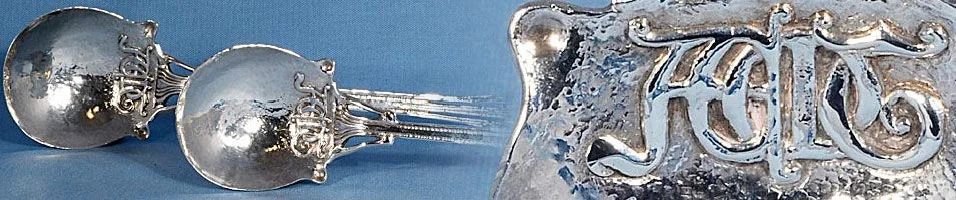
- Engraving. A coat of arms or crest cut when the piece was new is part of its history and usually helps. A later monogram is a mild drawback for a collector and irrelevant to melt value. An erased engraving is worse than either: the metal is left thin and slightly dished, which shows when the surface is tilted against the light. Never have initials removed before a sale.
- Repairs. Look for grey lead solder, patches let into the body, splits where a handle joins, and feet pushed up into the base.
- Later decoration. Many plain Georgian mugs, tankards and jugs were embossed with flowers and scrolls in the Victorian period. The marks say 1760 and the decoration says 1860, and collectors pay less for the result.
- Wear. Fork tines shortened by use or trimmed level, spoon bowls worn thin at the tip, and chased detail softened by a century of polish all reduce the premium.
Telling sterling from plate
Two kinds of plated ware are regularly taken for silver. Old Sheffield plate, made from the 1740s, is a sheet of copper with silver fused to its surface. Where the silver has worn through, at high points and edges, the copper shows pink. Electroplate, which replaced it after Elkington's patents of 1840, is a thin deposit of silver over nickel alloy or Britannia metal, and is commonly stamped EPNS, EPBM or A1. Makers of both often struck a row of small shields and initials laid out to resemble hallmarks. The test is simple: no lion passant, no English sterling.
Home tests have limits. A magnet proves little, because silver, copper and nickel alloy all ignore it; it will only expose plated steel. Buyers use two better methods. An acid test involves a small scratch and a drop of reagent and leaves a mark, so ask where it will be done and expect an inconspicuous spot. An X-ray fluorescence reader gives the alloy without touching the surface. Good Old Sheffield plate has its own collectors. Electroplate is rarely wanted by a metal buyer, and it is better to know that before loading the car.
The sale itself
Anyone selling sterling silver in Boca Raton or the neighbouring towns will find that the procedure follows a pattern: an appointment, proof of identity, a sorting of the lot, weighing, and an offer. Premier Estate Buyers, a local firm that dates its trade to 1984, describes free appraisals at its office and house calls across South Florida, and other established buyers work in much the same way. Under Florida's rules for secondhand dealers the buyer has to record the seller's photo identification, so bring it.
Preparation improves the outcome. Sort the pieces by their marks beforehand and keep services together. Weigh the plain sterling at home in grams and note the total, leaving out knives and filled pieces. Write down which objects you believe have a maker or a date that matters, and ask for those to be priced one by one, apart from the weighed lot. A free appraisal carries no duty to accept. For anything made before about 1750, or bearing one of the names listed above, a second opinion from an auction specialist is worth the delay. English hallmarks were designed to let a stranger verify a piece of silver without trusting the seller, and they still do that work at a buyer's table in Florida three centuries later.