Silver is one of the few antiques with a published price per ounce, and that cuts both ways. It gives a seller a floor that can be checked on any day of the week. It also tempts buyers and sellers alike to treat every piece as metal, which is how good Georgian silver ends up in a refiner's crucible. The checks in this guide are meant for anyone about to sell antique silver or the contents of an estate, and they apply equally to a single teapot and to a houseful.
Know roughly what you have
A seller who can describe a piece is treated differently from one who cannot. Before approaching anyone, read the marks and make a short list. English sterling carries a lion passant, a town mark, a date letter and a maker's initials, and the archive's introduction to antique silver sets out the standards of purity to which silver has been worked. Note which pieces are fully hallmarked, which are plated, and which bear foreign marks such as the number 800. Weigh the plain sterling in grams on a kitchen scale and keep the figures. There is no need to arrive as an expert. The aim is to know enough to follow what the buyer says and to notice when something is passed over.
How offers are made
There are two honest ways to price silver, and a good buyer uses both. The first is by weight. The buyer takes the weight in troy ounces, allows for purity (0.925 for sterling, 0.800 for the common continental standard) and multiplies by the spot price, then pays a stated share of that figure. The share is the buyer's margin, and a straightforward firm will tell you what it is. Ask which unit is on the scale. A troy ounce is about 31.1 grams, and a figure quoted in ordinary ounces or pennyweights cannot be compared with one in troy ounces until it is converted.
The second way is by the piece. Here the buyer looks at maker, date, form and condition and names a sum for the object, which should be above its metal value or there is no reason to price it separately. Most household lots call for a mixture: a weighed group of worn or common sterling, and a handful of things priced one by one. The split between those two groups is where most of the money is decided, so it deserves your attention.
Weighing in front of you
The scale should be on the table, in view, and reading zero before anything is placed on it. Sterling and lower-grade silver should be weighed apart, since they are paid at different rates. Knives with filled handles, candlesticks loaded with pitch, and pieces with wooden or glass parts should be set aside and estimated, and the buyer should say how the estimate was reached. Compare the total with the figure you brought from home. A small difference is normal between scales. A large one needs explaining before the conversation goes any further.
Some firms state this practice outright. The page for silver buyers serving Delray Beach, published by a family firm based in Boca Raton, describes hallmarks read aloud, weights shown to the seller, and sterling weight multiplied by the live spot price as a visible floor under the offer. That is the standard to hold any buyer to, in any town: every number that goes into the price is one you have seen for yourself.
Ask for an itemised offer
A single figure for everything on the table tells you nothing. Ask for the offer broken into lines: the weighed sterling with its total weight and rate, the lower-grade silver likewise, and then each individually priced object with its own sum. Plate, if the buyer takes it at all, should be listed separately so that it is clear nothing has been paid for it by weight.
An itemised offer does three things. It shows whether the buyer has recognised the better pieces. It allows you to accept part and withhold part, which matters if one figure seems low. And it gives you something to set beside a second opinion. A buyer who will only quote for the whole lot, and whose price changes when one piece is withdrawn, is averaging a strong piece against weak ones in a way you cannot check.
Does the buyer separate melt from antique value
This is the central test, and it can be observed. Watch whether the buyer picks up a loupe and reads the date letter, or goes straight to the scale. Listen for whether a duty mark or a Britannia mark is mentioned, whether a pair is noticed as a pair, and whether engraving is examined or ignored. The archive's guide to important silversmiths names the leading makers of each period, whose work should never be weighed in with scrap.
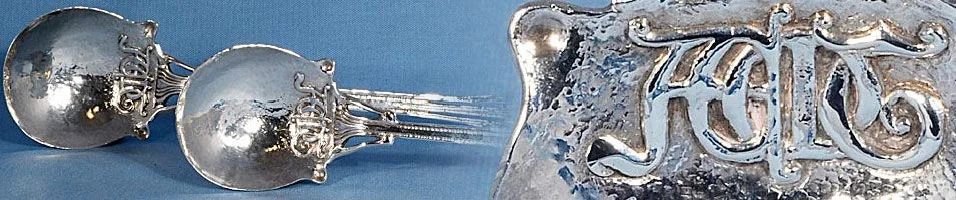
Some examples show what is at stake. A hammered bowl inscribed on the rim with the Latin signature of Omar Ramsden is collected as Arts and Crafts metalwork, and its weight is beside the point. The same holds for anything bearing the mark of Paul de Lamerie or Paul Storr, for early eighteenth-century salvers with contemporary armorials, and for small collectable forms such as vinaigrettes, caddy spoons and wine labels, which weigh almost nothing and are bought entirely for what they are. A buyer who says that it is all just silver in the end has told you how the lot will be priced.
The reverse also applies. A buyer who claims a large antique premium for ordinary late Victorian plate, or for die-stamped silver of about 1900, is either mistaken or flattering you, and the offer that follows may not match the talk.
Red flags
None of these proves bad faith on its own. Two or three together are reason enough to pack up and leave.
- The offer is good only if you accept before leaving the room.
- The scale is out of sight, or the weighing is done in a back office.
- The buyer will not say what share of the spot price is being paid.
- Pieces are filed, scratched or acid-tested without your permission being asked.
- Only a lump sum is offered, with no breakdown.
- The buyer has no fixed premises, for instance a short-stay buying event in a hotel suite.
- There is reluctance to hand pieces back while you consider.
- No identification is requested. Florida requires secondhand dealers to record a seller's photo identification, so a buyer who skips it is not following the rules that govern the trade.
- You are urged to have monograms removed or pieces polished first, at your expense.
Get more than one opinion
Two assessments are the minimum for anything beyond a few spoons, and three is better for an estate. Spot prices move, so try to gather offers within a few days of one another, and compare them line by line: the rate paid on weighed silver, and the sums named for the same individual pieces. Where two buyers disagree sharply about one object, that object probably deserves a specialist's view, and an auction house with a silver department will usually give an estimate from photographs of the piece and its marks.
Firms that buy whole estates should be judged on general grounds as well as on their handling of silver. Premier Estate Buyers in Boca Raton publishes a checklist for choosing an estate buyer which covers that wider ground: fixed premises, track record, openness about pricing and fees, references, and a summary of Florida's secondhand-dealer rules on identification and holding periods. It reads well alongside the silver-specific checks set out here, and it applies to any firm you may be considering.
Nothing obliges you to sell to the highest offer either. A buyer who explained every figure and priced the better pieces properly may deserve the business over one who named a slightly larger total without saying how it was reached, particularly if more is to be sold later.
What to bring
Preparation shortens the appointment and improves the offer.
- Government photo identification.
- Your own list, with the weights you took at home and a note of the marks.
- Every part of every object: lids, stoppers, liners, burners, salt spoons, and the keys of fitted cases.
- Boxes, cases and any receipts, old valuations or auction invoices.
- Sets kept together and labelled as sets.
- The silver as it is. Leave it unpolished, with tarnish in place.
- A second person, if you can, to listen and take notes.
For a large collection, or one that would be awkward to move, ask whether the buyer will come to the house. Seeing a collection in place often helps a competent assessor, because pairs, sets and cases are found together and nothing is left behind in a cupboard. Wherever the meeting takes place, the rule is the same. You should leave knowing the weight of what was sold as metal, the rate paid on it, and the separate price of every piece that was sold as an antique.