
Archive of the former catalogue of English antique silver
About Antique Silver
Text reproduced from the original antiquesilvercompany.com page.
Silver is a fascinating metal. The soft, white lustrous properties of silver and it's many amazing attributes have all helped to make silver a desirable metal for thousands of years. Silver's chemical symbol is Ag , this comes from the latin name argentum . It's atomic number is 47.
Silver has long been valued as a precious metal and has been, and still is used today for making various items from high-value tableware to fine jewellery. We continue to use silver today for it's conducting properties in electrical contacts and conductors. It is also used in mirrors and as a catalysis in chemical reactions.
Silver in it's pure form is considered too soft a metal to be used to for making things. This fact drove the search for a metal that could be mixed with the silver to both give it the required strength and to retain it's beauty. It was found early on that when mixed with a small amount of copper the silver became much stronger allowing it's use in silver items. Over the years many metals have been used to create silver alloys, some of which are far more resistant to tarnishing and others are more resistant to firescale. Today this search for the perfect blend is still continuing.
Over the years various purities of silver have been used and settled upon as standards. Some examples are listed below:
99.9 % is considered pure silver.
98.0 % was used extensively in Mexico between the years of 1930 and 1949.
95.84 % was the standard for Britinnia Silver produced between the years of 1697 and 1720.
95.0 % was used by the French, 1st Standard.
92.5 % is used extensively in British silver. This standard is called Sterling Silver and is denoted by the Lion Passant hallmark.
90.0 % was used in the USA for coins.
87.5 % was used in the former USSR.
8.3 % was used in Scandanavia.
80.0 % was the German standard after 1884.
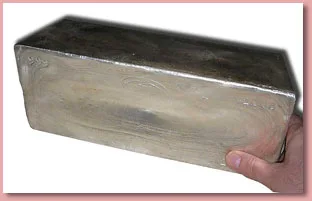
1000 oz block of 99.9% silver.
Silver compounds have a toxic effect on some bacteria, viruses, algae and fungi just like some other metals like lead and mercury, however silver is not toxic to humans. This fact has seen silver compounds used in various items such as clothing, I myself use silver impregnated socks when on my motorcycle as they help with odours by helping to keep bacteria and fungi at bay. People have, in the past, used silver bottles use store consumables such as wine and vinegar as it prolongs their life considerably. Silver coins have been used in the past to keep milk from going off to great success. Today in hospitals you will find that a lot of catheters are made of silver as the metal helps to stop infections caused by bacteria.
Silver is a great conductor of heat, this is why you commonly find that the handle of antique silver tea or coffee pots are insulated using ivory or bone sections. Some items actually use this property to their advantage, meat skewers are inserted into large joints whilst cooking. This draws the heat from the over into the inside of the joint helping it to cook evenly.
Meat Skewers help meat to cook evenly due to the heat conducting properties of silver.

The native form of silver is more often than not an alloy, usually found with gold and in ores containing sulphur, arsenic, antimony or chlorine. The principal sources of silver are ores of copper, copper-nickel, lead or lead-zinc. These ores are primarily found in Mexico, Australia, Chile, Peru, China, Poland and Serbia. Both Mexico and Peru have been mining silver since 1546 and are still the major producers of the world.
This all goes to support my argument that silver is simply special, function and beauty in one package.